In a city that’s constantly rewriting itself, some projects choose a quieter path forward.
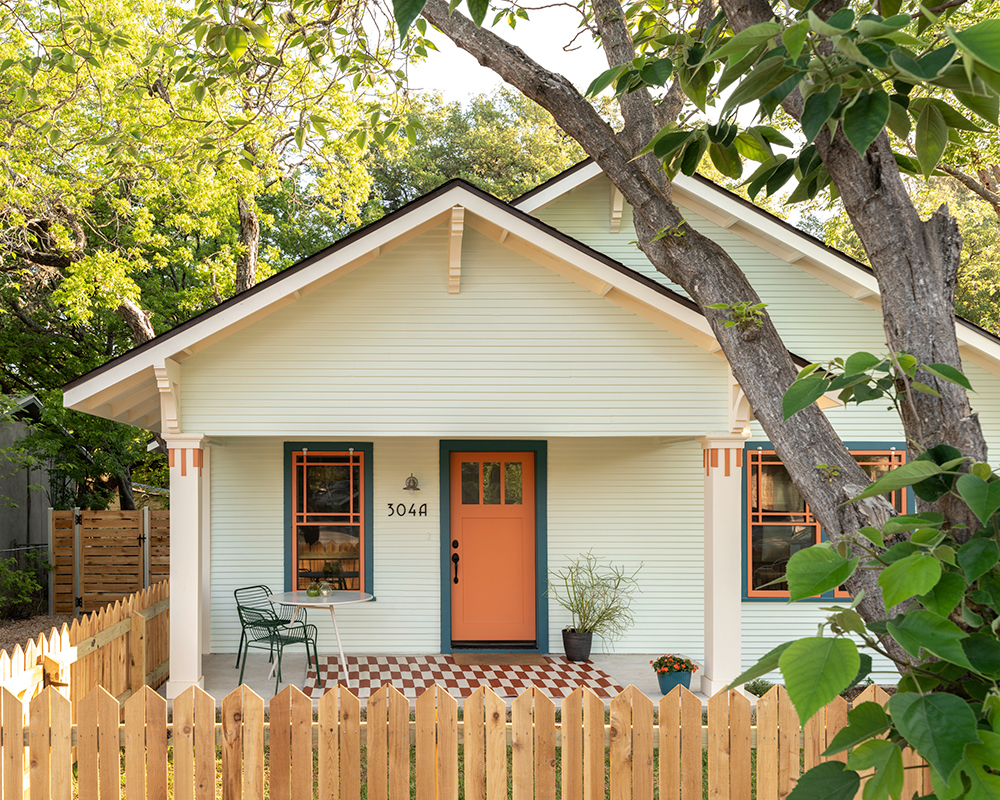
Soco Duo sits along a familiar stretch of South Congress—a neighborhood where the past still lingers in rooflines and front porches, even as new construction steadily fills in the gaps. Rather than starting from scratch, this home leans into what was already there, holding onto the character of a 1920s bungalow while gently expanding its possibilities.
We sat down with Harmony Grogan, founder of Pluck Architecture, to talk about the thinking behind the project—how preservation and progress can coexist on the same lot, why restraint often leads to more expressive design, and what it means to create a home that feels joyful without trying too hard.
What emerges in Soco Duo is less about transformation for its own sake, and more about continuity—a home that feels rooted in its surroundings, yet fully attuned to the way people live now.
Tell us a little about yourself and what led you to start Pluck Architecture.
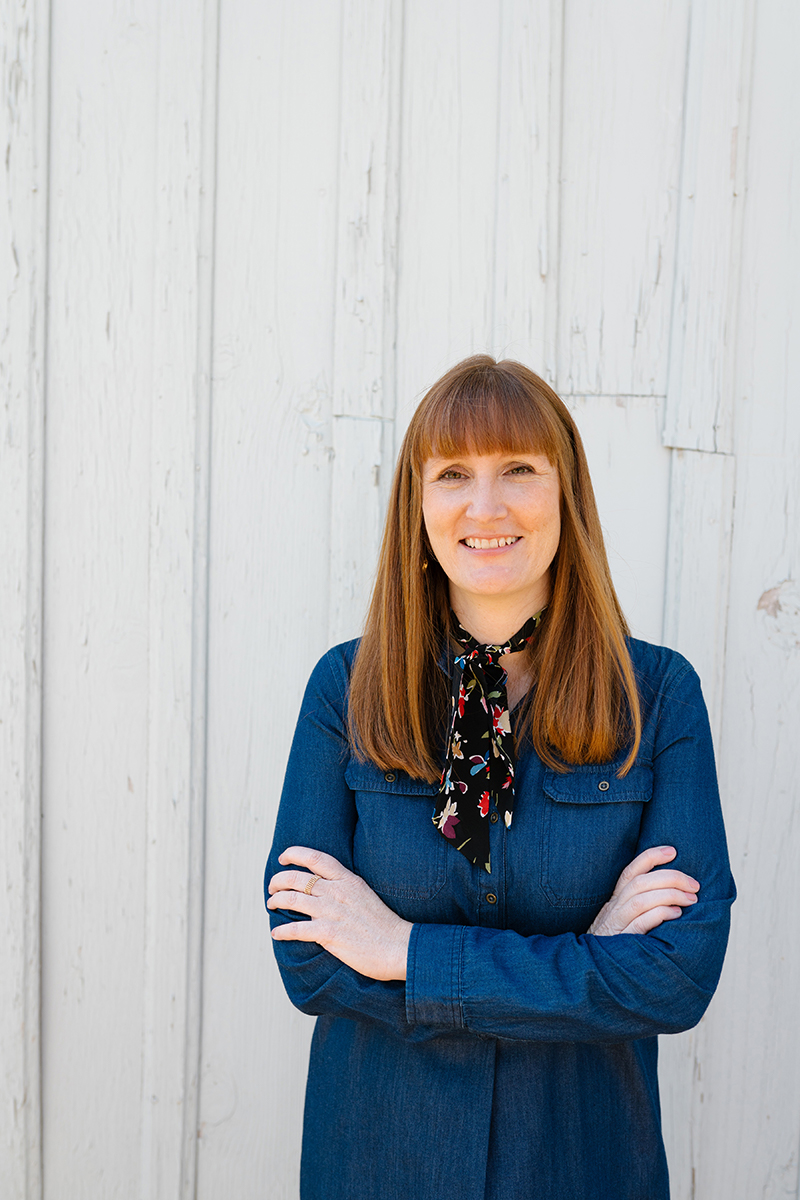
For as long as I can remember I always wanted to be an architect, but I hadn’t really considered starting my own firm early in my career. As my career progressed, I wanted more control over design decisions and the types of projects and clients I worked with. I also thought a woman-led firm could offer something different from what is a traditionally male dominated profession. When it came time to go out on my own, I knew I wanted the studio’s portfolio to include preservation work, alongside new construction and even small commercial projects. We’ve been lucky to work on a variety of projects that center around improving the everyday experience.
You’ve described yourself as an intrepid and client-focused designer. How do you balance creative vision with honoring your clients’ tastes and values?
It all starts with listening. We ask each client to come to us with their needs and wishes, but also with an open mind, free of preconceptions. Our role is to use our education, experience, and skill to interpret clients’ goals and translate that into a livable space. Often our design solutions vastly differ from the vision clients had originally developed in their head. It’s my opinion that the more collaborative relationships lead to most creative solutions and happy clients.
You’ve been part of the Austin architecture community since 2002 and have served in leadership roles with AIA Austin and Preservation Austin. How has that civic involvement shaped the way you approach residential design?
Civic involvement certainly grows your skill set and your network, but most importantly expands your perspective outside of your studio’s professional work. When you can use your expertise and training for the greater good and improve your local community, it can only inspire your daily professional work. I’ve always championed that architecture should be for everyone and I’m very proud of our more budget-based projects. Our studio takes a lot of pride in clever solutions that don’t have to break the bank or add excessive square footage. These solutions and necessary creativity then carry over to our larger projects that don’t have as many constraints.
I encourage every designer, of any age, to get involved in your community and become a citizen architect.
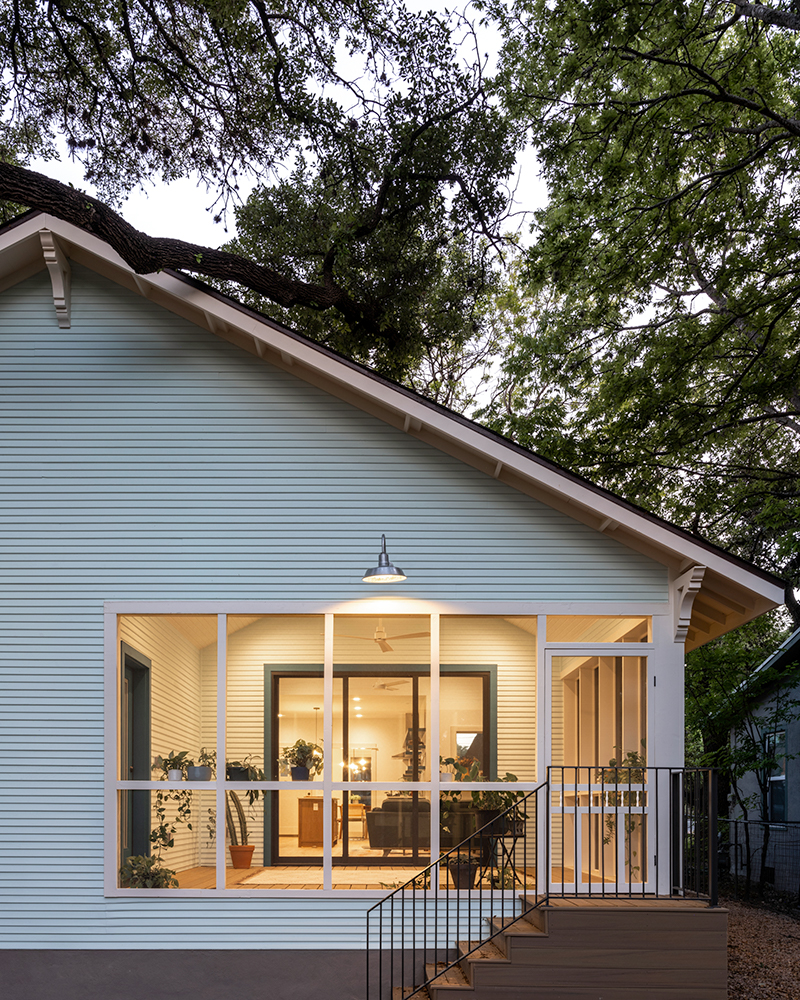
Soco Duo sits in one of Austin’s most iconic neighborhoods. What were the key considerations when designing in such a culturally and architecturally layered part of the city?
For the first decade after moving to Austin, I lived in an 1960s apartment complex across the street from this bungalow. I was excited with the opportunity since I was so familiar with the neighborhood. Unfortunately, the 1920-30’s bungalow style is quickly being lost in Austin, especially in this zip code. We knew from the first sketch that we wanted to maintain the front portion of the home because preserving the historic streetscape was critical to the whole project team. Any expansion of the footprint would need to be at the rear of the house and proportional to the scale of the existing structure. We maintained and rebuilt many details that were key to the historic fabric of the house, such as wood corbels, decorative window screens, and tear drop siding. The final product was a reimagined bungalow, adapted for today’s living standards, but the structure still embodies the history of the built neighborhood.
The color moments in Soco Duo feel confident but not overwhelming. How did you decide where to go bold — and where to keep things quiet?
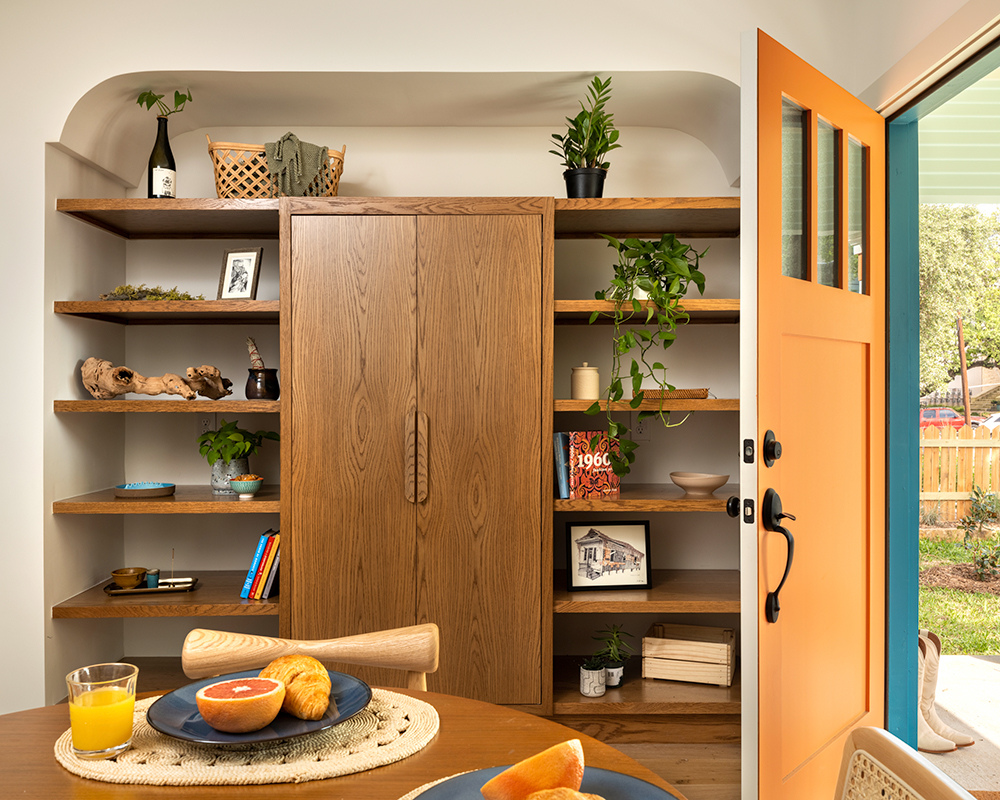
Design is about restraint. When every element is flashy, nothing gets noticed! Color was very integral here, as is the case with many of our projects. The clients were fond of the vibrant house colors of New Orleans and that directive led us to explore several color palettes for the exterior. We ultimately decided on a soothing light green that was fresh and clean for the body of the exterior. The orange accent color fits right in with the funky SOCO district. The interior is filled with warm wood floors and shelving, but there are plenty of areas with expressive color throughout. Cabinetry and built-in nooks all incorporate fun colors set in relief to the neutral walls and floors.
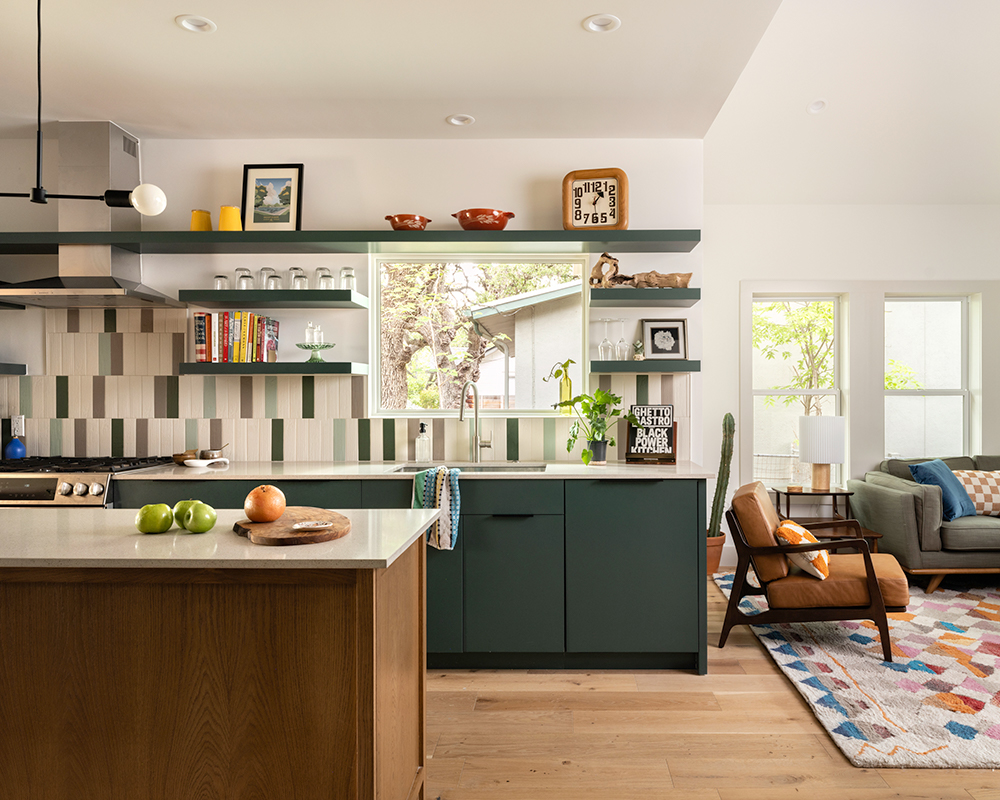
This house feels joyful. Was that a goal from the beginning, or did it evolve as the design developed?
Yes, it is a joyful house! It truly was a rebirth of a home that needed some love. I’m not sure it was a direct goal stated from the beginning, but something that developed organically as we learned more how the house would be inhabited and the design unfolded.
It follows a theme in my design. Joy is one of the most important elements that can often get lost by sparse contemporary design.
Soco Duo is a multi-unit residential project. The ADU could have felt like an afterthought — but it doesn’t. How did you make it feel just as intentional as the main home?
We always look to context to ensure that the design fits the surroundings, while also tailoring the design to the client and their desires. In this case, our clients were aligned with our philosophy. Our clients wanted the ADU to appropriately fit in the backyard and not overpower the main house. Restraint here was key. Additionally, the site has numerous protected heritage trees which limited the footprint of both the main house addition and the new ADU. There are several historical small homes in the neighborhood that we looked to for inspiration for the ADU. Both the site constraints and local architectural context guided us.
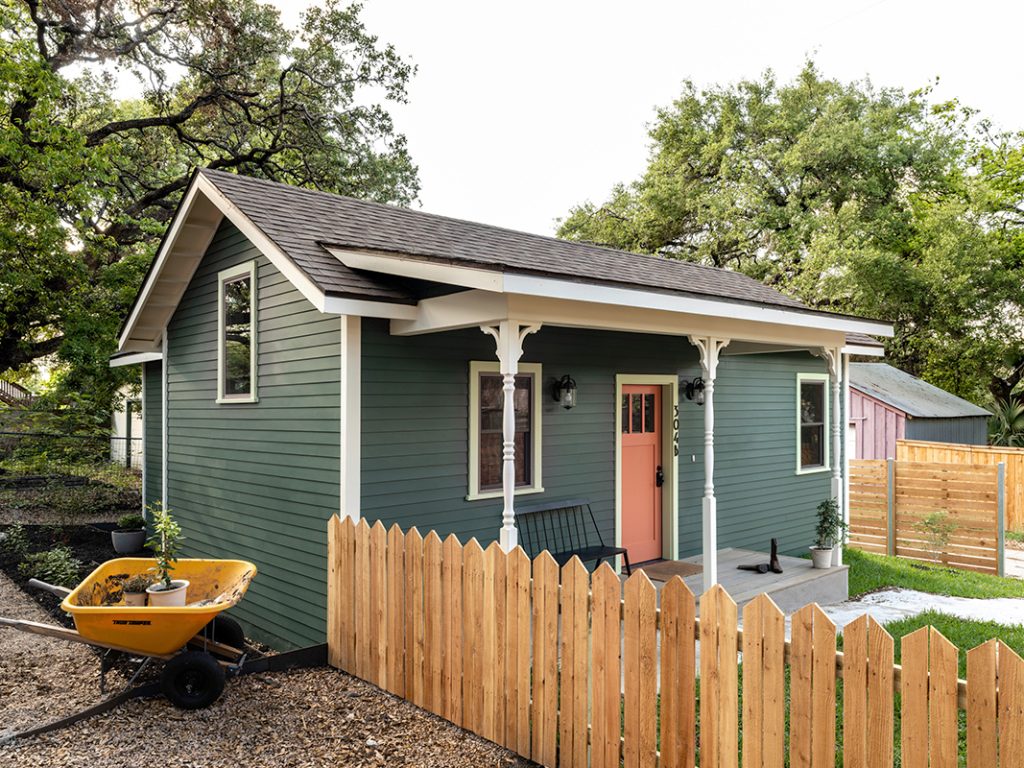
What part of Soco Duo makes you smile every time you walk through it?
It feels like an old house with new life! I take the position that most houses should have rooms versus a fully open floor plan. Not only does this allow for each room to have its own character with finishes, but the house unveils itself as you progress through. It leaves room for surprises. We flipped the public spaces, moving the dining to the front and the living to the rear, but kept rooms distinct. The new floor plan is strongly connected to the backyard with a screen porch and large windows that give ample views to the massive oak trees. This connectivity was lacking in the historical layout but doesn’t feel overly modern with the remodel. The historical is integrated with the contemporary, but neither old nor new is overpowering. It makes me smile that we achieved that with this house.
As someone who serves on the Historic Landmark Commission, how do you think about preservation and progress coexisting in a rapidly growing city like Austin?
It should coexist! In the best architecture, it does coexist. We need to see a balance between historical preservation and new development in Austin and more creative solutions to implement this balance. It’s not always understood what is lost when a historical structure is demolished. Preservation retains communities, fosters inclusion, and is environmentally sustainable. Maintaining even a portion of the historical fabric goes a long way in retaining these attributes. Austin’s new HOME ordinance provides so many opportunities for developing residential properties while preserving old homes.
Is there anything else you’d like readers to know about Soco Duo, your philosophy at Pluck Architecture, or designing in Austin today?
At Pluck, no two projects are the same. We’re committed to bringing creative solutions to challenging restraints. Our design process is rooted in collaboration with our clients and the entire project team. We care deeply about the built environment. I like to think that our eclectic sense of style brings joy and improves the everyday experience.
One last thing…
One word that captures Soco Duo?
Vibrant
A tiny design detail that makes you disproportionately happy?
Flush thresholds…haha. Working with older homes, it’s always a challenge as new and old floor surfaces meet.
A building in Austin you never get tired of looking at?
The Philips House by John S, Chase (1966)
Austin in three words?
Fun. Tacos. Sun.
Favorite Austin neighborhood?
I’m not sure I can play favorites. Austin recognizes eight local historic districts, all with high architectural integrity and rich history. Look them up and explore!
Contact
https://www.pluckarchitecture.com/
IG: @pluckarchitecture
+1 (512) 507-4096